Dentures vs Bridges for Missing Teeth: Non-Implant Options for Spring Valley Patients
Published · Updated
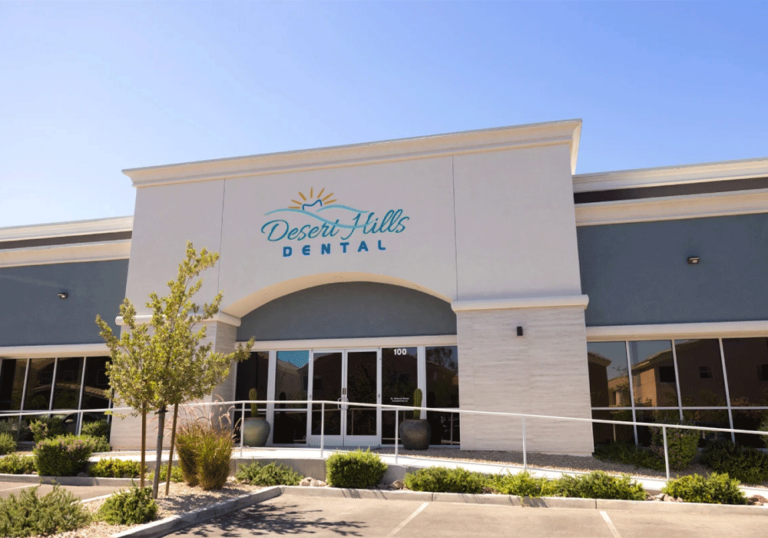
A bridge suits missing teeth that have strong, healthy teeth on either side, because it is cemented to those teeth and stays in. A partial denture is the usual choice when many teeth are missing and a bridge or implant isn’t feasible or affordable, and it comes out for cleaning and sleep. A full denture is for when no teeth are left. Desert Hills Dental, on South Fort Apache Road in Spring Valley, makes bridges and dentures and can tell you which one your mouth can support.
If you live in Spring Valley and an implant isn’t the route you want, here’s how the two non-implant options compare.
Key Takeaways
- The Merck Manual describes a bridge as a fixed partial denture held by crowns on the natural teeth either side of the gap.
- The Merck Manual says that once a bridge is cemented into place, it isn’t removed.
- The Merck Manual says the anchor teeth under a bridge bear all the stress of biting.
- A removable partial denture is commonly used when many teeth need replacing and a bridge or implant isn’t feasible or affordable.
- The Merck Manual’s consumer page says dentures restore less than 20% of the chewing ability of natural teeth.
What’s the difference between a bridge and a denture?
A bridge is fixed in place and a denture is removable.
The Merck Manual’s professional chapter on dental appliances (updated August 2026) says a bridge is false teeth joined to a crown at each end, cemented to the natural teeth beside the gap, and that once cemented it isn’t removed. A removable partial denture usually has clasps that snap over nearby teeth. A complete denture is used when no teeth remain.
| Option | How it stays in | Comes out at home? | Usually chosen when |
|---|---|---|---|
| Fixed bridge | Crowns at each end are cemented to the supporting teeth | No | The teeth beside the gap are strong enough to anchor it |
| Removable partial denture | Clasps over remaining teeth | Yes | Many teeth are missing and a bridge or implant isn’t feasible or affordable |
| Complete denture | Rests on the gums | Yes | No teeth are left in that jaw |
When does a bridge make sense?
When the teeth on each side of the gap are healthy enough to hold it.
The Merck chapter says those anchor teeth bear all the stress of biting, and each gets a crown. So the health of those teeth matters. Merck adds that one or several bridges can replace many of the teeth in an arch, so a bridge isn’t only for a single gap. Because the anchor teeth get crowned, ask your dentist how healthy those teeth are and whether crowning them makes sense.
Our crowns and bridges page explains that we use CEREC to make custom crowns and bridges.
When is a partial or full denture the better fit?
When many teeth are missing and a bridge or implant isn’t feasible or affordable, or when no teeth are left.
The Merck Manual’s consumer page on dental appliances (updated September 2026) says partial dentures are worn by people who need several teeth replaced but can’t have or can’t afford bridges or implants. Dentures can improve appearance and speech, but restore less than 20% of natural chewing ability, according to the same Merck page, and making them typically takes several months.
We make full and partial dentures. See our dentures page.
What does each one ask of you day to day?
A bridge is cared for in your mouth. A denture comes out to be cleaned.
Merck’s consumer page says to take dentures out after each meal, clean them with nonabrasive, nonwhitening toothpaste or baking soda on a soft brush, remove them before sleep and see a dentist at least once a year, because the mouth can change shape and dentures may need refitting. The professional chapter adds that the lower jaw slowly shrinks when no teeth are left, which is why complete dentures get relined or replaced. A bridge has nothing to take out, and the anchor teeth carry it.
What if an implant is still on the table?
Then compare all three before you decide. Merck’s consumer page says implants don’t decay and give a fixed option in place of a removable partial. Our guide to dentures vs implants covers that choice.
A quick way to narrow it down
- Missing teeth with strong teeth either side: ask about a bridge.
- Many teeth missing, and a bridge or implant isn’t feasible or affordable: ask about a partial denture.
- No teeth left in that jaw: a complete denture, or ask about implant options.
Seeing a dentist from Spring Valley?
Our office is at 6740 S Fort Apache Rd, Ste 100, Las Vegas, NV 89148, at the western edge of Spring Valley near Rhodes Ranch. Our Spring Valley page has more on visiting us. We’re insurance friendly with most PPO plans, and our financial page lists CareCredit, Cherry and our Complete Care Program.
Call (725) 307-5569 or use our contact page to book a consultation.
Frequently Asked Questions
Is a bridge or a partial denture better for missing teeth?
It depends on how many teeth are missing and how strong the neighboring teeth are. A bridge is fixed and leans on the teeth either side, which bear all the biting stress. A partial denture is removable and is commonly used when many teeth need replacing and a bridge or implant isn’t feasible or affordable.
Can I take a dental bridge out?
Not a fixed bridge. The Merck Manual says that once a bridge is cemented into place, it isn’t removed. If you want something that comes out for cleaning and at night, that’s a partial denture.
How well can I chew with dentures?
Less well than with natural teeth. The Merck Manual’s consumer page says dentures restore less than 20% of the chewing ability of natural teeth and don’t fully restore their feel.
How long does it take to get dentures?
Usually several months. The Merck Manual says making dentures typically takes several months and involves a sequence of carefully planned steps.
Who makes bridges and dentures near Spring Valley?
Desert Hills Dental, a general and family dental office at 6740 S Fort Apache Rd in Spring Valley, makes crowns, bridges, and full and partial dentures. Its three dentists, Deborah Staten, Fatima Nepacena and Janika Ross, all hold a DMD. Call (725) 307-5569 to book.
Medically reviewed by Deborah Staten, DMD, who leads the practice, and updated on November 2, 2026.